
A zero-percent tax rate doesn’t mean zero reporting. Many business owners assume that operating within a Free Zone or earning under the AED 375,000 profit threshold means they can bypass the Federal Tax Authority entirely, but UAE law draws a strict line between tax liability and the duty to file. Completing your corporate tax registration is an unconditional legal obligation for every licensed entity across the country, regardless of whether you anticipate owing tax.
If you feel overwhelmed trying to distinguish between Mainland and Free Zone mandates, you aren’t alone. Sorting through complex corporate records while trying to avoid the FTA’s fixed AED 10,000 late registration penalty creates understandable pressure for growing businesses.
This 2026 guide removes that stress. You will find clear confirmation of your filing obligations, a practical checklist of necessary documents, and a structured walkthrough of the EmaraTax digital platform so you can secure your Tax Registration Number with confidence.
Key Takeaways
- Understand why corporate tax registration is a mandatory statutory step for both Mainland and Free Zone entities, regardless of revenue levels or zero-percent tax qualification.
- Identify the core documents and structural corporate records you must assemble before accessing the EmaraTax digital platform.
- Learn the specific statutory deadlines that apply to your business structure to prevent fixed administrative fines.
- Discover the critical ongoing record-keeping and financial reporting standards required after receiving your Tax Registration Number.
What Is UAE Corporate Tax Registration and Who Must Apply?
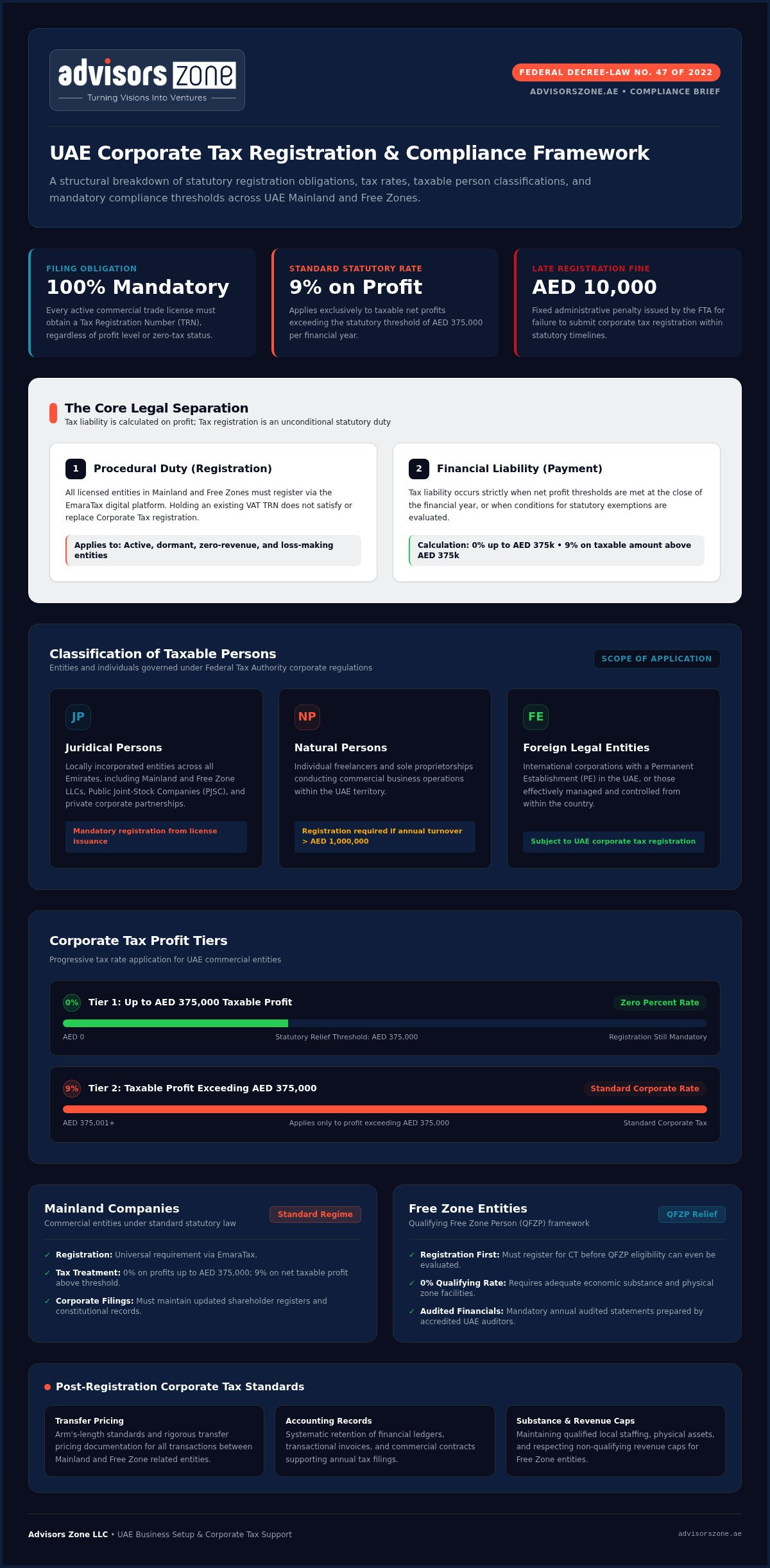
Corporate tax registration is the statutory process through which an enterprise registers with the Federal Tax Authority (FTA) to obtain a distinct Tax Registration Number (TRN). Governed by Federal Decree-Law No. 47 of 2022 and subsequent amendments, this formal filing establishes your enterprise’s legal tax profile in the UAE. It functions completely independently from Value Added Tax (VAT) credentials; holding a VAT TRN does not exempt you from enrolling for corporate income reporting.
Every commercial entity licensed in the Emirates must assess its registration obligations immediately upon receiving a trade license. The broader system of Taxation in the United Arab Emirates relies on universal registration, creating an administrative record for all active operations across both Free Zone jurisdictions and the mainland market.
Defining Taxable Persons Under Federal Tax Regulations
The FTA classifies taxable entities into specific categories that determine filing responsibilities:
- Juridical Persons: All locally incorporated corporate entities, including Limited Liability Companies (LLCs) such as Advisors Zone LLC, public joint-stock companies, and private partnerships across all Emirates.
- Foreign Legal Entities: International corporations effectively managed and controlled from within the UAE, as well as foreign organizations with a permanent establishment in the country.
- Natural Persons: Individual freelancers and sole proprietorships conducting commercial operations, provided their total annual turnover exceeds the statutory threshold of AED 1 million within a single calendar year.
The Distinction Between Registration Obligation and Tax Liability
A common misconception is that a business only registers when it turns a taxable profit. That isn’t how the legislation operates. Obtaining a TRN is a procedural duty, whereas paying tax depends entirely on your net profit calculations at the close of your financial year.
A standard 9% rate applies only to taxable profits exceeding AED 375,000, while net income up to that amount falls within the 0% threshold. Even if your entity operates at a loss, maintains zero revenue, or sits dormant under a valid trade license, you still hold an unconditional mandate to submit your corporate tax registration documents to the FTA. Incomplete or delayed submissions expose dormant licenses to the exact same administrative enforcement as multinational enterprises.
Corporate Tax Registration Rules Across Free Zones and Mainland
Your geographic licensing zone dictates your effective tax rate, but it never excuses you from registering. Both Mainland companies and Free Zone entities share an identical legal duty to obtain a Tax Registration Number from the Federal Tax Authority. Clarity on this principle is essential: registration is an administrative baseline across all Emirates, while tax treatment depends on operational activity, corporate structure, and statutory relief eligibility.
The UAE Government Corporate Tax portal outlines how corporate taxation applies nationally. Regardless of location, businesses transacting between Mainland and Free Zone entities must maintain rigorous transfer pricing documentation and arm’s-length transaction records.
Mainland Commercial Entities and Standard Registration Requirements
Mainland establishments follow standard statutory pathways under federal law. Operating under commercial frameworks like those outlined in the Mainland business guidelines means your entire taxable net income above AED 375,000 is taxed at the 9% rate. Preparing for corporate tax registration requires aligning your active commercial license, constitutional documents, and shareholder registers before submitting your EmaraTax profile.
Free Zone Companies and Qualifying Free Zone Person Status
Free Zone companies do not receive automatic exemptions. To benefit from a 0% corporate tax rate on qualifying income, an entity must establish itself as a Qualifying Free Zone Person (QFZP). Gaining this preferential treatment requires completing your initial corporate tax registration first; the FTA does not evaluate QFZP eligibility outside the formal tax system.
Maintaining QFZP standing involves strict compliance criteria:
- Adequate Economic Substance: Operating physical facilities, retaining sufficient qualified staff, and incurring operational expenditures directly inside the designated zone.
- Audited Financials: Preparing annual financial statements audited by an accredited UAE accounting firm.
- Non-Qualifying Revenue Caps: Keeping non-qualifying revenue below the de minimis threshold (the lower of 5% of total revenue or AED 5,000,000).
Different designated authorities have varying administrative requirements. While jurisdictions like RAKEZ and other business hubs offer efficient commercial licensing frameworks, tax treatments remain governed strictly by federal standards rather than individual zone rules.
Small Business Relief Considerations During Initial Registration
Resident taxable persons with gross revenue of AED 3,000,000 or less in a given tax period can elect for Small Business Relief. This provision treats the business as having no taxable income for that financial cycle, extending across tax periods ending on or before 31 December 2029.
Electing for this relief simplifies your annual return, but it does not remove the initial registration requirement. You must complete your registration on time and retain commercial books for seven years. If you need clarity on structuring your initial setup or evaluating relief thresholds, you can speak with our compliance team at Advisors Zone LLC for targeted guidance.
Step-by-Step Procedure to Complete Corporate Tax Registration
Filing through the official system demands rigorous administrative precision. The Federal Tax Authority manages all filings electronically through its EmaraTax digital platform, rejecting applications containing missing attachments or clerical contradictions. Preparing your business records in advance remains the most reliable way to avoid delays.
You can begin by reviewing the official Federal Tax Authority registration service, which coordinates digital identity verification with national business registries. Following a methodical, staged approach ensures your submission moves smoothly through review.
Document Preparation and Corporate Verification Checklist
Assemble high-resolution digital copies of these corporate records before starting your application:
- Commercial Licensing: A valid copy of your primary trade license along with any associated commercial register certificates.
- Signatory Credentials: Passports and Emirates IDs for all individual owners, partners, and officially appointed managers.
- Constitutional Documents: Your current Memorandum of Association (MOA), Articles of Association (AOA), or equivalent founding charter.
- Legal Representation: A notarized Power of Attorney (POA) or board resolution confirming the authority of your appointed signatory.
Navigating the EmaraTax Portal Application Workflow
Log in to the EmaraTax platform using your established UAE Pass credentials or registered tax portal login. From the main administrative dashboard, add your taxable person profile by entering the legal name exactly as shown on your trade license.
Select the option to start a corporate tax registration and input your entity’s core profile, including legal structure, financial year dates, and registered commercial activities. Attach your verified PDF documents within the designated upload modules, ensuring each file satisfies system legibility requirements. Review all entered shareholder ownership percentages carefully before confirming your final submission.
Application Review and Receiving Your Tax Registration Number
Once you submit, your file moves directly into processing with the FTA. Check your dashboard periodically for notifications; the authority may issue an administrative Request for Information (RFI) if an uploaded document appears blurry or an authorized signatory requires secondary confirmation.
Following successful verification, the authority issues your formal Certificate of Corporate Tax Registration containing your official TRN. Download this document and store it securely within your corporate archives alongside company formations like your Free Zone documentation. You will need this number for all forthcoming tax return filings and corporate banking correspondence.
Registration Deadlines, Compliance Timelines, and Avoidable Errors
Meeting statutory timelines protects your company from needless administrative liabilities. The Federal Tax Authority enforces strict registration cutoffs across all jurisdictions, and missing these cutoffs disrupts operational continuity. Because corporate banking facilities depend on active compliance records, delays can quickly spill over into routine financial transactions.
Understanding Official Federal Tax Authority Submission Deadlines
For existing legal entities, the FTA implemented staggered deadlines throughout 2024 based on the calendar month of original commercial license issuance. If your entity was incorporated on or after 1 March 2024, the statutory deadline is clear: you must complete your submission within three months from your incorporation date.
Natural persons carrying out commercial business follow an independent calendar. If your gross turnover exceeds AED 1,000,000 in a calendar year, you must register by 31 March of the following year. Missing these statutory windows results in administrative action regardless of your revenue levels.
Administrative Penalties and Commercial Risks of Delayed Filing
Failing to submit your application on time carries a fixed administrative penalty of AED 10,000. Under an FTA penalty relief initiative, taxpayers who incurred this fine can have it waived or refunded, provided they file their first tax return within seven months from the end of their first tax period. Even with this relief window, avoiding the fine altogether remains the safer operational choice.
Commercial fallout extends beyond official fines. UAE commercial banks routinely demand a verified TRN during annual Know Your Customer (KYC) updates. Failing to produce a tax certificate can restrict outbound payments, freeze lines of credit, or delay mandatory corporate renewals. Understanding how banks assess your company profile is equally important; corporate bank account assistance in the UAE can help you organize your business activity, ownership structure, and licensing documents into a consistent picture that supports a clearer banking application.
Frequent Mistakes to Avoid During the Registration Phase
Simple clerical oversights frequently derail online filings. Keep your corporate documentation clean by watching out for these recurring pitfalls:
- Submitting Expired Documents: Uploading trade licenses, passports, or Emirates IDs near expiration triggers automatic requests for clarification, resetting your review queue.
- Mismatched Activity Classifications: Your chosen EmaraTax business activity codes must align precisely with the commercial activities printed on your commercial permit.
- Overlooking License Renewals: Your underlying trade license must remain fully active during submission. You can consult the complete guide to maintaining a business license in the UAE to verify your operational permits before applying.
Navigating strict timelines and precise portal entries requires methodical oversight. To ensure your business documents align with current statutory requirements without unexpected delays, reach out to our business setup team for comprehensive registration support.
Post-Registration Obligations and Managing Ongoing Tax Compliance
Securing a Tax Registration Number completes your initial enrollment, but it also triggers ongoing administrative responsibilities. In practice, corporate tax registration marks the start of formal tax governance rather than the finish line. Every registered business must establish reliable financial workflows to meet Federal Tax Authority expectations across subsequent operating cycles.
Mandatory Recordkeeping and Accounting Standards
Federal tax legislation requires all taxable entities to retain invoices, commercial books, ledgers, and bank statements for at least seven years after the relevant tax period ends. Businesses must prepare their balance sheets and income statements in line with recognized accounting principles, primarily International Financial Reporting Standards (IFRS).
Internal controls must also track related-party dealings. Any commercial transactions between connected businesses or individual shareholders must follow arm’s-length standards and carry verifiable transfer pricing documentation.
Annual Return Filing Cycles and Payment Frameworks
Your annual corporate tax return deadline depends directly on your formal financial year. The FTA requires every registered entity to file its tax return and pay any assessed liability within nine months from the end of the tax period. If your financial calendar ends on 31 December 2025, your official filing and payment deadline is 30 September 2026.
Missing these filing dates carries consequences:
- Late Return Submissions: A recurring penalty of AED 500 per month applies for the first 12 months of delay, escalating to AED 1,000 per month thereafter.
- Late Tax Payments: Overdue tax balances incur an administrative penalty of 14% per annum, calculated and applied on a monthly basis.
- Zero-Activity Filings: Dormant companies or businesses with net operational losses must still lodge an official return by the statutory deadline.
How Advisors Zone LLC Supports Your Corporate Compliance
Staying compliant with federal mandates begins long before your first annual return is due. Advisors Zone LLC guides entrepreneurs, foreign investors, and domestic businesses across the UAE through company formation, trade licensing renewals, and corporate tax registration preparation. We examine your active commercial operations and ownership structures in detail to identify potential filing bottlenecks before submitting files to EmaraTax.
Whether you manage a startup or a multi-entity group, our team provides practical administrative assistance to help you organize your records and maintain good standing. Reach out to Advisors Zone LLC Compliance Support to review your company records and complete your mandatory filings accurately.
Secure Your UAE Business Compliance for 2026 and Beyond
Completing your corporate tax registration on time protects your enterprise from administrative penalties and ensures your commercial banking relationships remain uninterrupted. Whether you run a Free Zone company aiming for Qualifying Free Zone Person standing or manage an established Mainland operation, staying ahead of Federal Tax Authority deadlines keeps your commercial ventures fully compliant.
Having supported more than 60,000 entrepreneurs in establishing and structuring operations across the UAE, Advisors Zone brings reliable regulatory insight to your business setup journey. Backed by a client trade license renewal rate of nearly 90%, our specialists guide both Mainland and Free Zone enterprises through corporate document preparation and EmaraTax portal submissions. Don’t let administrative hurdles slow down your strategic growth. Connect with Advisors Zone for corporate tax assistance today and secure your company’s regulatory future with total confidence.
Frequently Asked Questions
Is corporate tax registration mandatory for all UAE companies?
Yes, corporate tax registration is mandatory for all legal entities operating in the UAE. Federal Decree-Law No. 47 of 2022 requires all juridical persons, including LLCs, public corporations, and private partnerships, to register with the Federal Tax Authority. This mandate applies across Mainland and Free Zone jurisdictions regardless of whether your business is pre-revenue, operates at a loss, or generates millions in taxable income.
Do Free Zone companies need to register for UAE corporate tax?
Yes, Free Zone entities must complete registration with the Federal Tax Authority. Operating in a Free Zone doesn’t exempt any business from statutory enrollment. While a Qualifying Free Zone Person can benefit from a 0% rate on qualifying income, accessing this preferential rate requires obtaining a Tax Registration Number first. Without formal registration, your business can’t claim statutory tax incentives and faces standard administrative fines.
Can a business operate without a corporate tax registration number?
No, continuing commercial operations without obtaining a TRN breaches federal tax compliance mandates. While your trade license allows you to launch, statutory regulations require you to submit your tax registration within designated deadlines. Operating past these legal windows exposes your enterprise to a fixed AED 10,000 administrative fine. Furthermore, UAE financial institutions routinely block transactions if companies don’t supply verified tax certificates.
What documents are required to complete corporate tax registration?
Completing your corporate tax registration requires assembling official corporate identification and active commercial permits. You must prepare digital copies of your valid trade license, certificate of commercial registration, and Memorandum of Association. You will also need passports and Emirates IDs for all business owners, partners, and managers, alongside a notarized Power of Attorney or board resolution proving signatory authority for the portal submission.
How long does it take to obtain a Tax Registration Number?
Processing times depend entirely on the Federal Tax Authority’s verification queue and application completeness. Once submitted through the EmaraTax digital platform, applications are typically reviewed within several business days to a few weeks. The authority may issue clarification requests for blurry scans or missing records. Government approval timelines can’t be guaranteed, so preparing your application early remains the best operational practice.
Does corporate tax registration require immediate payment of taxes?
No, submitting your registration doesn’t trigger an immediate corporate tax payment. Registration is strictly an administrative onboarding step that establishes your company’s profile within the national tax infrastructure. You calculate your tax liability only after your financial year concludes. Registered businesses have up to nine months after their financial year-end to file their annual corporate return and pay any tax due on profits above AED 375,000.
What happens if a company misses the corporate tax registration deadline?
Missing your statutory filing deadline results in a fixed administrative penalty of AED 10,000 imposed by the Federal Tax Authority. Beyond immediate monetary fines, missing deadlines can disrupt corporate banking relationships and complicate future trade license renewals. The FTA provides a penalty waiver initiative if businesses file their initial return within seven months of their period end, but registering on time remains the best compliance strategy.