
What if your choice of a uae business license was actually the single most important financial decision you’ll make this year? Many entrepreneurs view licensing as a mere administrative hurdle, a box to tick before they can finally start trading. It’s completely natural to feel a sense of hesitation when faced with the choice between Mainland and Freezone jurisdictions. You might worry about hidden government fees or feel uncertain about how your license type impacts your long term visa eligibility. These are valid concerns that can stall even the most ambitious startup plans if they aren’t addressed with clarity.
We agree that the regulatory environment can seem complex, but it doesn’t have to be a barrier to your success. This guide provides a comprehensive roadmap for 2026, ensuring you understand every requirement and cost implication before you commit. You’ll learn the strategic differences between various setups and how to identify the perfect fit for your specific business activity. We’ll walk through the essential steps of the application process, compare jurisdiction benefits, and outline the path to securing your residency visas with total confidence.
Key Takeaways
- Identify the strategic differences between Mainland and Freezone jurisdictions to determine which setup offers the best operational flexibility for your specific goals.
- Learn how to select the correct category for your uae business license to ensure full compliance with the latest 2026 commercial and professional regulations.
- Follow a structured five-step roadmap that simplifies everything from choosing your business activity to receiving your final legal documentation.
- Understand the critical link between your trade license and your eligibility for residency visas, Golden Visas, and corporate banking approvals.
- Prepare for essential post-licensing requirements, including establishment cards and VAT registration, to maintain smooth business operations from day one.
Understanding the UAE Business License: Why It Is Mandatory
A uae business license serves as the legal foundation for every commercial, professional, and industrial activity within the Emirates. It’s much more than a simple permit; it acts as your company’s birth certificate and legal identity. Whether you’re launching a massive logistics firm or a small digital consultancy, obtaining this document is the first mandatory step in your entrepreneurial journey. Without this registration, any commercial activity is considered illegal and can lead to severe penalties or deportation.
The requirement for licensing extends to all sectors, including digital entrepreneurs and remote-first startups. If you’re operating from the UAE, you must be registered with a relevant authority even if you don’t have a physical storefront. This license is the essential key that unlocks critical business functions. You cannot legally lease office space, secure an establishment card, or apply for residency visas for yourself and your staff without it. Most importantly, UAE banks require a valid trade license to open any corporate account. This makes it impossible to manage business finances legally without proper documentation.
The Legal Framework for Licensing in 2026
Federal regulations in the UAE dictate that every business must register with a specific licensing authority based on its location and activity. Choosing an activity that precisely matches your license type is vital. If your license doesn’t reflect your actual operations, you risk facing significant fines or operational delays. The UAE trade license is the primary document for legal business operations.
In Dubai, the Department of Economy and Tourism (DET) manages Mainland company formation. Conversely, Freezone Authorities manage specific industry clusters, offering specialized environments for tech, media, or manufacturing. Each jurisdiction has its own set of rules, but the federal mandate for legal registration remains consistent across the board. Advisors Zone can help you identify which authority aligns with your specific goals to ensure you’re compliant from day one.
Benefits of a Valid Business License
Holding a valid license provides immediate access to the UAE’s world-class infrastructure and its strategic position as a global trade hub. It offers more than just the right to trade; it provides a framework for growth and security. You aren’t just buying a piece of paper; you’re investing in a structure that supports your long-term presence in the region.
- Sponsorship and Hiring: You gain the legal right to sponsor residency visas for partners, employees, and their families.
- Legal Protection: Your business operates under a robust legal framework, offering protection under UAE commercial and corporate laws.
- Global Market Access: A license allows you to engage with international suppliers and clients, leveraging the UAE’s extensive network of double taxation treaties and trade agreements.
By establishing a legal entity, you also build trust with local vendors and government entities. This credibility is essential for participating in large-scale projects or securing government contracts, particularly if you opt for a Mainland setup.
Mainland vs. Freezone: Choosing the Right Jurisdiction
Deciding where to register your company is the most critical strategic choice in the setup process. Your choice of a uae business license jurisdiction dictates where you can trade, who your clients can be, and how much physical space you need to maintain. While both options offer high growth potential, they serve very different operational needs. You must weigh the benefits of local market access against the specialized industry benefits found in economic zones.
Ownership structures also vary between these choices. Professional licenses generally focus on individual expertise and service delivery, whereas Commercial licenses cover the trading of goods. In the past, Mainland setups required a local partner for commercial activities, but current regulations allow 100% foreign ownership in most sectors. This change has narrowed the gap between jurisdictions, making the decision more about your specific business activity and office requirements rather than just ownership control.
When to Choose a Mainland License
Mainland companies are registered with the Department of Economy and Tourism (DET). This setup is ideal for businesses that want to trade directly with the local UAE market or bid for lucrative government contracts. One of the biggest advantages is operational flexibility. You can open offices anywhere in the Emirates without geographic restrictions, which is essential for retail, construction, and localized services.
For consultants and service providers, the Dubai Mainland Professional License is a popular choice. It allows you to offer your expertise to any local or international entity while maintaining full control of your business. Unlike Freezones, Mainland licenses typically require a physical office lease registered with Ejari. This provides a permanent base of operations that can help build long term trust with local vendors and financial institutions.
When a Freezone License is More Strategic
Freezones are specialized economic hubs that offer 100% foreign ownership and specific customs benefits. They are perfect for startups, tech companies, and international consultancies that don’t require a physical presence in the local UAE market. Most Freezones offer “flexi-desk” or co-working solutions. These options significantly reduce initial overhead costs for new entrepreneurs who aren’t ready for a full office lease.
Strategic clusters provide a competitive edge by grouping similar businesses together. For instance, Meydan is highly sought after for e-commerce and digital businesses due to its modern infrastructure. If you’re focused on industrial or manufacturing setup, Rakez offers tailored facilities and logistics support. For those seeking a cost-effective entry point with minimal administrative hurdles, Anc Freezone provides flexible packages that prioritize speed. If you’re still debating the best path for your activity, you can speak with a setup expert to compare these options side by side.
Primary UAE Business License Categories
Selecting the right category for your uae business license is a strategic decision that defines your legal scope and operational boundaries. Each category facilitates specific economic functions, ensuring the government can effectively monitor and support different sectors. You aren’t just picking a label; you’re choosing the framework that will govern your contracts, banking relationships, and growth potential.
- Commercial License: This is the most common type, covering all trading activities where goods are bought and sold. It includes general trading, specialized retail, and the rapidly growing e-commerce sector.
- Professional License: Designed for individuals or companies providing services based on intellectual or artistic talent. This includes consultants, designers, engineers, and healthcare professionals.
- Industrial License: If you’re involved in manufacturing or processing raw materials into finished products, this is the required permit. It necessitates having a physical factory or warehouse in the UAE to meet regulatory standards.
- Tourism License: Specialized for the hospitality sector, this covers travel agencies, tour operators, and hotel management. It often requires additional approvals from the Department of Economy and Tourism.
Matching Your Activity to the Correct License
Picking the wrong activity code is a common mistake that leads to significant compliance issues. If your operations don’t align with your license, you’ll likely face delays when trying to open a corporate bank account. Banks perform strict due diligence to ensure your business model matches your legal registration. A mismatch can flag your business as high-risk during the KYC (Know Your Customer) process.
You can often group multiple related activities under a single uae business license, which provides operational flexibility without needing separate registrations. Advisors Zone assists in this selection process by analyzing your business model and ensuring 100% regulatory alignment. This proactive approach saves time and prevents future administrative hurdles that could stall your launch.
Specialized Licenses for Modern Entrepreneurs
The UAE has introduced flexible licensing options to support the modern digital economy. E-trader licenses allow home-based entrepreneurs to sell products or services via social media platforms legally. While these are cost-effective, they often have limitations on physical storefronts or hiring capacity compared to standard commercial setups.
Freelancer permits are another popular entry point, but it’s vital to compare them against a full business license. A full license generally offers better long-term growth, as it allows you to hire employees and scale your operations more easily. For non-residents, virtual company licenses offer a way to manage a UAE-registered entity from abroad. These come with specific eligibility requirements that depend on your business activity and nationality, so it’s essential to verify your status before applying.
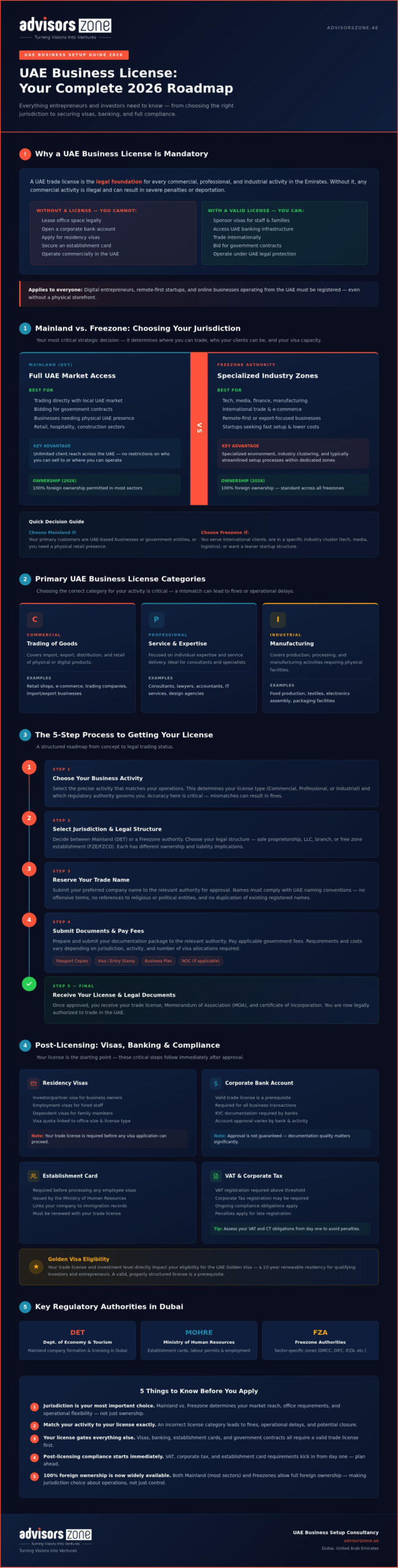
The 5-Step Process to Obtaining Your License
Securing your uae business license requires a logical approach to satisfy both legal and regulatory standards. While the specific paperwork can vary by emirate, the core roadmap remains consistent for most entrepreneurs. You don’t have to manage this alone. Following a structured sequence ensures you don’t miss critical milestones that could lead to application rejections or unnecessary delays.
- Step 1: Determine your business activity and legal structure. Clearly define what your company will do. This choice dictates whether you’ll form a Limited Liability Company (LLC), a Sole Establishment, or a Civil Works company.
- Step 2: Choose your jurisdiction. Decide between Dubai Mainland or a Freezone setup based on your target market and office needs.
- Step 3: Register your trade name and apply for initial approval. Submit your preferred business name for government clearance. Initial approval confirms that the UAE government has no objection to you starting a business.
- Step 4: Draft the Memorandum of Association (MOA) and lease agreement. The MOA outlines the ownership and operational rules of your company. You’ll also need a physical address, evidenced by an Ejari certificate for Mainland or a lease for Freezone.
- Step 5: Submit final documents and pay government fees. Once the authority reviews your final application, you’ll receive a payment voucher. The final issuance of your uae business license occurs immediately after payment.
Document Requirements for 2026
You must prepare a standard set of documents to begin the process. This typically includes clear passport copies, current visa copies, and No Objection Certificates (NOCs) if you’re currently employed in the UAE. Mainland setups often require documents to be legalized and translated into Arabic by certified professionals. Managing these “document clearing” phases can be time-consuming. Our PRO services handle these interactions with government authorities on your behalf, ensuring every signature and stamp meets the latest 2026 standards.
Timelines and Expectations
Speed is often a priority for new investors. Freezone approvals are generally faster, with some jurisdictions offering license issuance in as little as 48 to 72 hours. Mainland processes can take slightly longer because they involve more government departments. If your activity requires external approvals from bodies like the KHDA for education or the DHA for healthcare, expect additional steps. While some licenses issue quickly, external approvals depend on current government rules. If you’re ready to start the application, you can contact our team for a step-by-step consultation.
Post-Licensing: Visas, Banking, and Compliance
Receiving your uae business license is a major milestone, but it’s the beginning of your operational journey. You need to transition from a legal entity to a functioning business by securing your immigration status and financial infrastructure. This phase requires meticulous attention to detail to avoid administrative bottlenecks that could delay your official launch. Managing these steps correctly ensures your company remains in good standing with all regulatory bodies from day one.
Compliance also extends to the long-term health of your company. Nearly 90% of clients choose to renew their trade licenses with Advisors Zone because we provide a proactive approach to these recurring requirements. We don’t just help you start; we ensure you have a clear roadmap for maintenance, from annual license renewals to updating your establishment records. This continuity is essential for maintaining trust with your bank and government authorities.
Visa and Immigration Support
Once your license is issued, the first step is applying for an Establishment Card. This document officially registers your company with the immigration authorities, allowing you to sponsor residency visas. Many entrepreneurs opt for a Freezone business license with 1 visa to get started quickly with minimal overhead. This package is often the most efficient way for solo founders to secure their residency and begin operations.
If you’re a high-potential founder or a significant investor, we also provide specialized Golden Visa assistance to secure long-term residency. Understanding the full range of UAE residence visa options available in 2026 is essential for choosing the right immigration path that aligns with your business structure and long-term goals. This legal status isn’t just for you; it enables you to sponsor your family and hire the talent you need to scale. We manage the entire process, from the initial medical fitness test to the final Emirates ID issuance, so you can focus on your business goals.
Financial and Tax Compliance
Opening a corporate bank account is often the most challenging part of the setup process. Banks have rigorous KYC (Know Your Customer) requirements. You’ll need to present your uae business license, a signed Memorandum of Association, and proof of a physical or virtual address. We assist by identifying the most suitable banking partners based on your business activity and preparing your application to meet their specific compliance standards.
Taxation is another critical area where you must stay ahead of the curve. Every business must register for Corporate Tax, regardless of whether they meet the profit thresholds for the 9% rate. Even if you have zero tax liability, corporate tax registration remains a mandatory legal requirement for every licensed entity. Similarly, you must monitor your revenue to determine when you cross the threshold for mandatory VAT registration. Our team provides the necessary support to ensure you meet these deadlines without fail.
Need help choosing the right UAE business setup? Advisors Zone can review your intended activity, ownership requirements, visa needs, and preferred jurisdiction and guide you through the company formation process.
Launch Your UAE Venture with Confidence
Securing your uae business license is the first step toward building a successful commercial presence in one of the world’s most dynamic markets. By now, you should have a clearer understanding of the strategic differences between Mainland and Freezone jurisdictions, the importance of precise activity selection, and the critical post-licensing steps required for full compliance. Whether you’re a solo founder seeking a streamlined Freezone setup or an established firm targeting the local Mainland market, the right preparation ensures a smooth transition into operations.
Advisors Zone has helped more than 60,000 entrepreneurs navigate these requirements with personalized, expert guidance. As an authorized channel partner with major Free Zones across the Emirates, we handle the administrative heavy lifting so you can focus on growth. From initial trade name registration to complex visa and banking assistance, our team provides the foresight needed to avoid common hurdles and administrative delays.
Get Expert Help with Your UAE Business License
Your entrepreneurial goals are within reach, and with a reliable partner by your side, the path to success in the UAE is clear and manageable.
Frequently Asked Questions
What is the cheapest business license in the UAE for 2026?
Freezone setups remain the most affordable entry point for new entrepreneurs. A basic Freezone company formation starts at AED 4,000, while a package including a uae business license and one residency visa is available for AED 8,500. These costs represent the initial setup fees and don’t include external government charges. Choosing a remote-first or virtual setup helps minimize overhead while providing full legal status for your operations. For a detailed breakdown of every fee involved, including hidden e-channel and typing charges, refer to our comprehensive guide on Dubai trade license cost for 2026.
Can I own 100% of my UAE business with a Mainland license?
Yes, current regulations allow foreign investors to maintain 100% ownership of their Mainland companies for most business activities. This landmark change removed the previous requirement for a local Emirati partner to hold a majority stake in commercial entities. Whether you’re applying for a professional or commercial license, you can now enjoy full operational control. This flexibility makes the Mainland an attractive option for those targeting the local market directly.
How long does it take to get a business license in the UAE?
Timeline expectations depend on your chosen jurisdiction and the complexity of your business activity. Freezone approvals are remarkably efficient; they often result in a license issuance within 48 to 72 hours. Mainland applications typically take a few business days longer due to additional government department reviews. If your sector requires external approvals from specialized authorities, the process might extend, though some standard licenses are issued almost immediately after payment.
Is a physical office mandatory for all UAE business licenses?
Requirement for physical space varies by license type. Mainland companies must generally lease a physical office and register an Ejari certificate to meet licensing standards. Conversely, many Freezones offer flexible “flexi-desk” or co-working solutions that satisfy the legal requirement for a business address without the cost of a full office. This makes Freezone setups ideal for startups or digital businesses that don’t need a large physical storefront.
Can I trade across the whole UAE with a Freezone license?
Freezone companies can trade freely within their specific zone and internationally. However, if you wish to sell goods directly to the local Mainland market, you usually need to work through a local distributor or establish a Mainland branch. Professional service providers in Freezones often have more flexibility in serving Mainland clients, but it’s essential to verify the specific regulations for your uae business license to ensure full compliance.
What is the difference between a trade license and a professional license?
The primary distinction lies in the nature of your business activity. A trade license, also known as a commercial license, is mandatory for businesses involved in buying and selling physical goods or e-commerce. A professional license is designed for individuals or firms providing services based on their intellectual or artistic expertise, such as consultants or designers. Your choice affects your legal structure and ownership options, so matching your activity correctly is vital.
Do I need a UAE business license to work as a freelancer?
Yes, operating as a freelancer without a legal permit is prohibited. You must obtain either a specific freelancer permit or a professional license to offer your services to clients legally. These permits allow you to issue invoices, open bank accounts, and apply for residency visas. While they are often cheaper than full corporate setups, they provide the necessary legal protection to operate your solo venture without risking government penalties or fines.
What are the penalties for operating without a valid business license?
Operating a business without proper registration is a serious offense that carries severe consequences. Penalties include heavy financial fines, the immediate closure of your business, and potential deportation for foreign nationals. Additionally, you won’t be able to open corporate bank accounts or secure legal contracts with vendors. Maintaining a valid license is the only way to ensure your investment remains protected under the national commercial and corporate legal framework.